
How Do You Choose the Best Delivery Bag in Bangladesh?
Let’s be honest — nobody really thinks about delivery bags until something goes wrong. Food arrives cold, packaging is soaked through from the rain, or a bottle has tipped and leaked everywhere. That’s usually the moment a business owner realises the bag they handed their rider three months ago was never going to cut it.
Choosing the right delivery bag in Bangladesh is, arguably, one of the more underrated operational decisions a business can make. It may not feel glamorous next to branding or app development, but the bag your rider carries is often the last physical touchpoint between your business and your customer. Get it wrong, and you’re fighting an uphill battle on customer satisfaction regardless of how good the food or product actually is.
With Dhaka, Chittagong, and Sylhet seeing real growth in food delivery and e-commerce, the local market for delivery equipment has expanded considerably. The options, though, can feel overwhelming. So here’s a practical look at what actually matters.
Why the Bag Is More Than Just a Bag
Think of a delivery bag as a small, moving warehouse. Its job is to maintain conditions — temperature, structural integrity, dryness — from the moment your rider picks up the order to the second it lands at a customer’s door. A poorly built bag doesn’t just fail at that job quietly; it tends to fail visibly, with consequences your business absorbs directly.
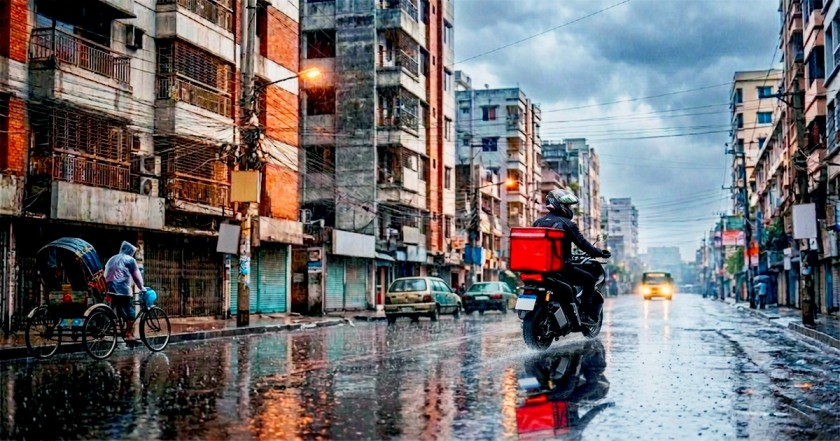
Bangladesh’s climate makes this particularly unforgiving. The combination of heat, humidity, and months of heavy monsoon rain puts bags under conditions that would stress even reasonably well-made products. A bag that performs fine in a temperate climate may start peeling, sweating, or losing its insulating properties within weeks here. That’s not a hypothetical — it’s a pattern that local delivery businesses encounter fairly regularly.
What to Actually Look For
Insulation — and not just any insulation
The insulation is what the bag actually does. High-density foam or multi-layered thermal lining tends to hold temperature far better than the thin foil lining you’ll find in cheaper options. For hot food, you want a bag that can hold heat for at least 45 minutes under outdoor conditions. Cold delivery — dairy, medicine, frozen items — needs a bag that won’t let ambient heat creep in within the first ten minutes of a ride.
It’s worth testing this before committing to a bulk order. Fill the bag with warm food, ride for 30 minutes in midday heat, and check the temperature on arrival. That tells you more than any product description will.
Waterproofing
During monsoon season, a non-waterproof delivery bag is essentially useless. Oxford fabric, coated nylon, and treated polyester all hold up reasonably well in heavy rain — but the seams and zipper closures matter just as much as the outer material. Water finds gaps. A bag that’s waterproof on the body but has exposed zipper seams will still let moisture in.
Size — matched to what you actually deliver
Delivery bags in Bangladesh generally fall into a few practical size categories:
- Small — single meals, snacks, or small orders from a café or bakery
- Medium — the workhorse for most restaurant deliveries with two to four items
- Large — grocery runs, pharmacy orders, or multi-bag restaurant orders
- Extra-large — corporate logistics, catering, or high-volume courier operations
Oversized bags for small orders create a different kind of problem — items shift around during transit, and hot food loses temperature faster in a partially filled bag. Sizing actually matters.
Build quality under daily wear
A delivery bag in active use might be opened and closed 30 to 50 times a day. Zippers fail. Stitching gives way. Handles fray. The stitching at stress points — where handles attach, where the zipper runs along the opening — is where you’ll first see a cheap bag start to break down. Reinforced stitching and heavy-duty YKK-style zippers aren’t a luxury at this usage rate; they’re what separates a three-month bag from a two-year one.
Rider comfort over long shifts
This one tends to get overlooked until a rider complains — or worse, quits. A bag that’s heavy when empty, sits awkwardly on the back, or puts all its weight on one shoulder becomes a genuine ergonomic problem over an eight-hour shift. Padded shoulder straps, a chest strap for stability on a motorbike, and even load distribution across the back panel can reduce fatigue meaningfully over time.
Branding — the case for custom bags
A rider on a motorcycle with a branded bag is, effectively, a moving billboard. In a city like Dhaka where street-level visibility is high, this has some real value. Custom logo printing or embroidery isn’t just aesthetic — it signals that a business is organised and invested in its presentation. That perception carries weight with customers who haven’t ordered from you before but spot your rider in their neighbourhood.
The Types of Delivery Bags Worth Knowing About
The market has segmented fairly clearly by use case:
- Thermal food delivery bags — the standard for restaurant delivery; designed to hold temperature during transit
- Backpack delivery bags — built for motorcycle and bicycle riders, keeping the load stable and hands free
- Flat-bottom pizza bags — a specific design that keeps pizza boxes level and prevents toppings from shifting
- Cooler bags — for cold chain items like medicine, dairy, and frozen food where temperature control is non-negotiable
- Grocery delivery bags — high-capacity bags with internal dividers, used by online grocery platforms
- Custom corporate bags — branded and often reinforced for courier companies running high daily volumes
SIHA Bag Factory — A Local Manufacturer Worth Knowing
For businesses sourcing delivery bags locally, SIHA Bag Factory is one of the more established manufacturers operating in the Bangladesh market. They produce a range that covers most of what a delivery business would need — insulated food bags, backpack-style rider bags, large grocery carriers, and custom-branded options for companies that want their own identity on the bag.
What tends to matter most when sourcing locally is the ability to actually inspect and test products before committing, get fast replenishment when bags wear out, and avoid the lead time and import costs that come with ordering from abroad. SIHA Bag Factory sits in that local-supplier space, with materials reportedly selected with Bangladesh’s climate conditions in mind rather than simply sourced generically.
Some aspects that make them a practical option for local businesses:
- Local production means shorter lead times — useful when you need to replace worn-out stock quickly
- Custom branding services — logo printing and colour options for businesses that want a consistent visual identity
- Bulk pricing structures — relevant for restaurant chains, e-commerce platforms, or courier companies ordering at volume
- A product range that spans small single-order bags to large pharmaceutical and grocery carriers
- Manufacturing oriented toward Bangladesh’s conditions — heat, humidity, and monsoon rain rather than a temperate default
Buying in Bulk — A Few Practical Notes
If you’re equipping a team of riders rather than just picking up a handful of bags, the purchasing process deserves a bit more structure. A few things that tend to save money and headaches:
- Get a sample first — run it through actual delivery conditions for a week or two before ordering fifty
- Weigh the empty bag — it matters more than it sounds when your rider carries it for eight hours
- Ask about zipper and stitching warranty — some manufacturers will replace defective bags; many won’t unless you ask upfront
- Factor in reorder frequency — a cheaper bag that lasts four months may cost more annually than a midrange bag lasting eighteen
- Order from a supplier who can restock quickly — running out of bags mid-operation is a real operational disruption
Where the Market Is Heading
Bangladesh’s delivery sector has changed considerably in a short span of time. Platforms like Chaldal, Pathao Food, and Foodpanda have pushed consumer expectations up — same-day delivery, tracked orders, and professional presentation have gone from a differentiator to something approaching a baseline expectation in urban areas.
That shift has a downstream effect on what businesses need from their equipment. A bag that was acceptable three years ago — functional but unlabelled, decent but not particularly weatherproof — may not hold up to the impression a business now needs to make. Smaller operations, in particular, are starting to understand that a ৳500 bag purchased without much thought can quietly undermine an otherwise strong customer experience.
Final Thoughts
There is no single best delivery bag in Bangladesh an absolute sense — there’s the bag that fits what you deliver, how far your riders travel, and what conditions they work in. Insulation quality, waterproofing, size, build durability, and rider comfort are the variables worth evaluating carefully rather than just going with whatever’s cheapest or most available.
For businesses looking to source locally, SIHA Bag Factory appears to be one of the more credible manufacturing options in the Bangladesh market — particularly if custom branding or bulk volume is part of what you need.
The bag your rider carries says something about your business before the customer even opens the door. It’s worth taking that seriously.
Meta Description: Delivery bags in Bangladesh matter more than most businesses realize. A no-fluff guide to choosing the right one for real local conditions.
FAQ’s
Q1: How long should a good delivery bag keep food hot?
Answer: A quality insulated delivery bag should maintain food temperature for at least 3-4 hour under outdoor conditions — enough for most urban delivery routes in Dhaka or Chittagong.
Q2: Are delivery bags waterproof?
Answer: Not all of them. Look for bags made from Oxford fabric, coated nylon, or treated polyester with sealed seams and waterproof zippers — especially important during monsoon season.
Q3: What size delivery bag do I need?
Answer: It depends on your order type. Small bags suit cafés and snacks, medium bags handle most restaurant orders, and large or extra-large bags work for groceries, pharmacy items, or catering runs.
Q4: Can I get custom branded delivery bags in Bangladesh?
Answer: Yes. Manufacturers like SIHA Bag Factory offer logo printing and colour customisation for businesses that want branded bags for their riders.
Q5: How many times a day is a delivery bag typically used?
Answer: A bag in active use can be opened and closed 30 to 50 times daily, which is why zipper quality and reinforced stitching at stress points matter so much for long-term durability.
Q6: Is it worth buying delivery bags in bulk?
Answer: Yes, if you’re equipping a team. Bulk orders typically come with better pricing, and having spare stock avoids operational disruption when bags wear out.