
The School Bag Manufacturer in Bangladesh: Beyond the Price Tag
Bangladesh’s reputation in textiles is built on garments. That much everyone knows. What gets far less attention is what happens in the factories beside the garment blocks — the bag workshops, the cutting halls, the stitching lines turning out school bags by the millions. The school bag manufacturer in Bangladesh sector is not a footnote to the apparel industry. It’s a story in its own right, and one worth telling properly.
From neighbourhood workshops in Dhaka to full-scale, export-ready production facilities, the country has developed real capacity in bag manufacturing. This piece looks at how that happened, what quality actually means in this context, and why SIHA Bag Factory has become one of the more respected names in the field.
Why Bangladesh? The Infrastructure Argument
The short answer is that bag manufacturing piggybacks on infrastructure that already exists. Bangladesh has spent decades building out textile mills, precision cutting facilities, and a workforce that knows how to stitch to specification. These are not skills you improvise. They accumulate over years of production pressure, and they transfer directly from garments to bags.
Raw materials — nylon, polyester, canvas, foam padding — are sourced locally or through well-worn import channels, which keeps per-unit costs down. That cost advantage does reach the buyer, and Bangladeshi school bags tend to be priced competitively against comparable products from other manufacturing hubs. But pricing alone doesn’t explain why international procurement bodies keep returning.
Cost gets you in the door. Consistent quality is what keeps the contract.
Government export policy helps too. Bonded warehousing arrangements, preferential trade terms, and access to Chittagong port — one of South Asia’s busier shipping hubs — make Bangladesh logistically practical for buyers sourcing at volume. These are structural advantages, not marketing language.
What Actually Makes a School Bag Good?
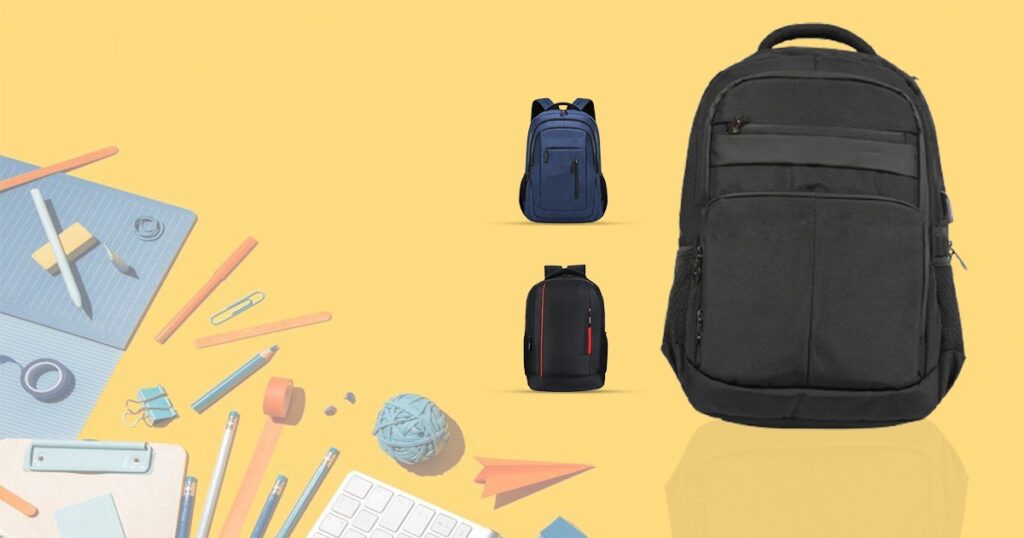
It’s worth pausing on this question, because the answer is less obvious than it looks. A school bag that fails a child’s back after three months of daily use is not a quality product, regardless of how it scored on a factory inspection checklist. Quality, in this context, is a function of how a bag performs under the specific conditions of school life — which are harder on equipment than most adults remember.
Material specification matters first.
High-denier polyester or nylon — the kind that resists abrasion over years of use, not just the first season — is the baseline. Anything below 600D for the outer shell is probably a compromise someone made to hit a price point.
Ergonomics matter next, and this is where cheaper bags tend to fall short in ways that aren’t immediately visible. Padded shoulder straps that actually distribute weight across the shoulder rather than digging in. Back panels with some structure — not just a flat piece of foam. These details protect a growing spine, or don’t. School bag manufacturers who take this seriously consult load-distribution guidance when designing strap systems, rather than simply copying whatever sold well last season.
Zippers are underrated. A YKK-grade zipper — or equivalent — rated for thousands of open-close cycles is simply not the same product as the anonymous zipper on a cheaper bag. One will last the year. The other probably won’t.
Compartment design rounds it out. A well-considered school bag places heavier items close to the spine and leaves accessible pockets for things a student needs quickly — a water bottle, a transit card, a charger. Getting this right requires someone to actually think about how students use bags, not just how they look in a product photo.
How a School Bag Is Actually Made
Understanding the production sequence helps explain why price variation between factories exists. A factory cutting corners at any stage creates a worse product — and the corners are usually invisible until the bag is already in use.
1. Material Sourcing and Inspection
Fabric rolls, zippers, buckles, webbing, foam, and lining material arrive and are inspected before entering production. Factories with consistent output tend to work with a stable set of certified suppliers rather than shopping for the cheapest option each run. The difference shows in batch-to-batch consistency.
2. Pattern Making and Cutting
Each panel — front, back, side, base, pocket — is cut from fabric using precision dies or computer-aided cutting systems. This stage determines dimensional consistency across units. Manual cutting introduces variation; precision cutting reduces it.
3. Stitching and Assembly
Industrial sewing machines stitch the cut pieces together. Seam strength is where quality diverges most visibly. Stress points — strap attachment zones, base corners, zipper surrounds — need multiple stitch lines and bar-tacking. A bag that pulls apart at the shoulder attachment after two months has failed at this stage.
4. Hardware and Zipper Attachment
Zippers, D-rings, buckles, and cord pulls are fitted. Precision matters here — a misaligned zipper track doesn’t smooth out with use, it worsens.
5. Quality Control
Finished bags go through multi-point inspection: zipper pull weight, seam strength, strap load capacity, visual finish. Factories working to AQL (Acceptable Quality Level) standards are checking against a defined tolerance, not just eyeballing the product.
6. Packing and Dispatch
Tagged, individually packed, and dispatched to domestic distributors or export partners. Many factories handle custom branding, private-label packaging, and retail-ready presentation — which matters to buyers who don’t want to manage a separate packaging supplier.
SIHA Bag Factory: What Sets Them Apart
Among school bag manufacturers in Bangladesh, SIHA Bag Factory has built a reputation that holds up when you get past the sales material. The factory serves domestic buyers and international importers alike, covering school bags for every age group — from primary-level kids’ packs to structured backpacks for university students.
Their range includes lightweight everyday school bags, multi-compartment academic backpacks, and ergonomic designs developed specifically for younger children. The breadth is useful for buyers who’d rather consolidate sourcing with one supplier than manage three separate relationships.
What appears to differentiate SIHA Bag Factory isn’t any single product feature — it’s process discipline. Custom orders, whether small institutional runs or large-volume retail procurement, go through the same production and QC pipeline. That consistency is what buyers tend to cite when asked why they return.
Key Advantages Worth Knowing
- Wide range of school bag styles — from basic to ergonomic, with consistent quality across the line
- High-specification materials: durable polyester outer shells, structured padded back panels
- Custom branding, logo printing, and private-label packaging — no separate supplier needed
- Flexible minimum order quantities, making SIHA practical for institutions and retailers, not just large importers
- QC processes that reference international standards, not just internal pass/fail criteria
- Factory-direct pricing with documented lead times
- Demonstrated experience in both domestic supply and international export logistics
For schools, procurement bodies, NGOs, and retail importers, SIHA Bag Factory offers end-to-end procurement support — from initial specification through to final delivery.
The Range: What Bangladesh’s Factories Actually Produce
The variety of school bag types coming out of Bangladeshi factories is broader than most buyers initially expect.
Primary school bags are built for children still developing the shoulder and back strength to carry weight. Light fabrics, soft straps, and simple compartments a seven-year-old can operate independently. The design constraint here is weight, above all else.
Standard academic backpacks — the 600D or 900D polyester workhorse — handle the bulk of school-age demand. Multiple compartments, a water bottle sleeve, a durable base. Most institutional buyers are purchasing something in this category.
Laptop school bags serve older students and university-goers. A padded laptop sleeve, organiser panel, and carry handle alongside shoulder straps. The material spec tends to be higher, and so does the price point.
Trolley school bags — wheeled, with a telescopic handle — have become popular for younger students carrying heavy textbook loads. They solve a real ergonomics problem, though they come with their own durability requirements around the wheel assembly and handle mechanism.
Institutional school bags are produced in bulk for schools, academies, or government supply programmes. Uniform colour, custom logo, standard dimensions. Volume is the key variable, and consistent batch-to-batch quality is what makes or breaks a supplier relationship in this segment.
The Export Picture school bag manufacturer
Bangladeshi school bag manufacturers are not serving the domestic market alone. Export destinations span South Asia — India, Nepal, Sri Lanka — through the Middle East, into the UK and Europe, and across parts of Africa. The pricing gap relative to comparable Chinese-manufactured products may run 20–40% lower, which makes Bangladesh attractive to cost-conscious buyers.
Sustainability: Where the Industry Actually Stands
This question deserves a direct answer rather than reassuring generalities. The sustainability picture in Bangladeshi bag manufacturing is mixed and improving — at different rates across different factories.
Recycled PET (rPET) fabric, made from post-consumer plastic bottles, is now available as a production option at a number of Bangladeshi factories. It’s not universal, and it does add cost. Water-based dyes are gradually replacing more chemical-intensive alternatives in better-run facilities. Third-party labour audits — covering wages, working conditions, and child labour prohibitions — are becoming standard for factories exporting to European buyers, though compliance depth varies considerably.
Buyers with specific sustainability requirements should ask detailed questions rather than accepting general assurances. The better manufacturers will have documentation. Those that can’t produce it are probably not yet where they claim to be.
Conclusion
The school bag manufacturing industry in Bangladesh has moved past the point where ‘cheap’ is the primary selling proposition — if it ever really was. The industrial base, the skilled labour pool, and the improving quality culture have made it a credible sourcing destination for demanding buyers. Not every factory meets that standard. But the ones that do are worth knowing.
SIHA Bag Factory sits near the front of that group. Whether the requirement is an institutional order of a few hundred bags or a large-volume export run of tens of thousands, the production capability appears to be in place. The logical next step is to verify that directly — samples exist for a reason.
For enquiries, bulk orders, or custom school bag specifications, visit sihabagfactorybd.com and speak with their team.
Frequently Asked Questions
Q1. Where can I find a reliable school bag manufacturer in Bangladesh?
SIHA Bag Factory is a well-regarded option, offering factory-direct pricing, customization capability, and documented QC processes for both domestic and international orders.
Q2. Do SIHA Bag Factory accept custom school bag orders?
Most do, including SIHA Bag Factory. Custom branding, specific colorways, size variations, and design modifications are standard.
Q3. Are Bangladeshi school bags exported internationally?
Yes. Bangladesh exports school bags to South Asia, the Middle East, Europe, and Africa. Experienced factories handle export documentation and international logistics as a standard part of the service.